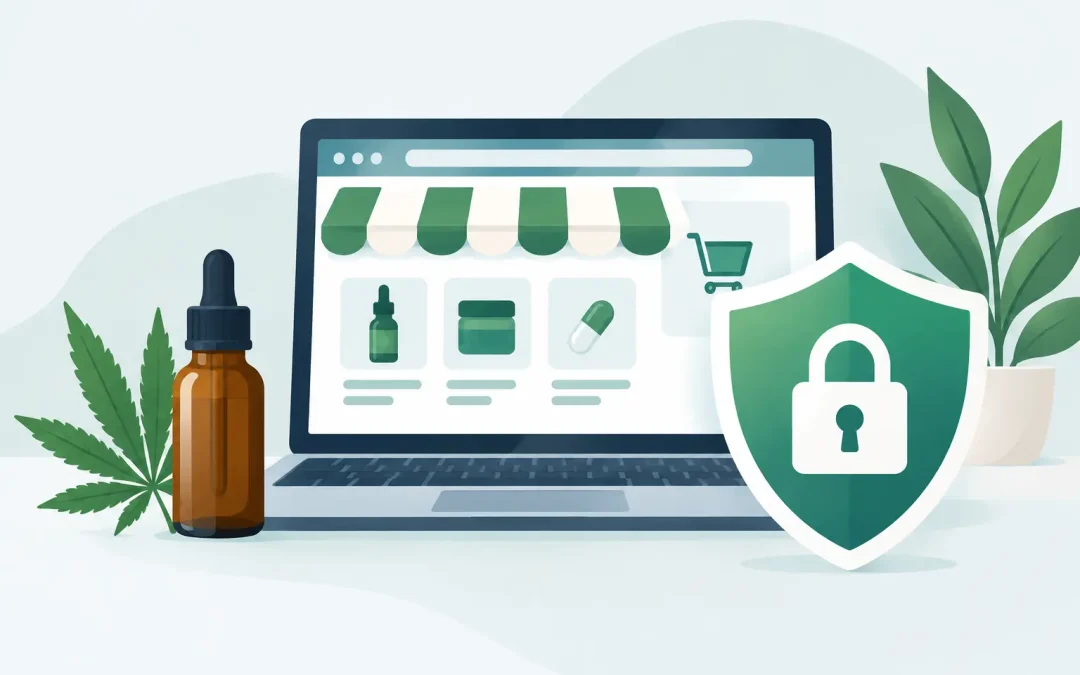
A customer may never see your hosting control panel, but they will notice a browser warning before they ever see your CBD products. Meeting CBD SSL requirements is not just a technical box to check. It protects customer information, supports a credible checkout experience, and helps keep your store from looking unsafe at the exact moment a shopper is ready to buy.
For a CBD business, trust is already a major part of the sale. Customers may be comparing ingredients, reviewing lab results, checking shipping policies, and deciding whether your company is legitimate. A secure HTTPS connection will not prove product quality, but an insecure website can quickly create doubt.
What CBD SSL Requirements Actually Mean
SSL is the familiar term, although modern websites use TLS, the newer security protocol. An SSL certificate enables HTTPS, encrypting information sent between a visitor’s browser and your website. That can include contact form entries, account passwords, customer addresses, and checkout details.
At a basic level, CBD SSL requirements mean your public website should load over HTTPS with a valid certificate that matches your domain name. The certificate must be current, installed correctly, and delivered with the full certificate chain. Your server also needs to support current encryption standards.
A padlock icon alone is not the whole job. If parts of a page, such as product images, scripts, fonts, or embedded forms, load through an unsecured HTTP address, browsers can flag mixed content. That creates warnings, broken page elements, or a checkout page customers do not trust.
Your goal is straightforward: every customer-facing page should use HTTPS consistently, and the browser should see a valid, trusted connection from the first visit through order confirmation.
The Technical SSL Checklist for a CBD Website
A properly secured site does not need an expensive certificate by default. It does need careful setup. Whether you run a WordPress content site, a WooCommerce store, or a custom-built CBD website, verify the following areas before launch and after major site changes.
Use a valid certificate for every live domain
Your certificate must cover the exact domain customers use. If both examplecbd.com and www.examplecbd.com resolve to your site, cover both names or redirect one version cleanly to the other. A mismatch between the certificate and the address in the browser causes immediate security alerts.
Most small CBD businesses can use domain-validated certificates. These confirm control of the domain and provide the same encryption strength as more expensive options. Organization-validated certificates add company verification, which some businesses prefer for added identity signals. Extended-validation certificates involve more review and typically cost more, but they do not create a special browser bar or guarantee higher conversion rates.
The right choice depends on your operations. A simple informational CBD site may only need a standard certificate. A larger company managing multiple brands, domains, and subdomains may benefit from a multi-domain certificate or wildcard certificate. A wildcard can protect subdomains such as shop.yourdomain.com and wholesale.yourdomain.com, but it may not cover every naming scenario. Confirm the coverage before purchase.
Force HTTPS sitewide
Installing a certificate is only step one. Your web server should redirect HTTP requests to HTTPS using a permanent redirect. Set the preferred HTTPS address in WordPress and in your ecommerce platform, then test common entry points: the homepage, product pages, cart, checkout, account pages, blog posts, and contact forms.
Do not leave both HTTP and HTTPS versions available. Search engines can treat them as separate versions, and customers may land on the insecure one through an old bookmark, a campaign link, or a third-party listing.
If you are moving an existing site to HTTPS, update internal links, image URLs, canonical tags, sitemap entries, and tracking settings. A partial migration is where mixed-content problems usually appear.
Keep TLS settings current
Your hosting environment should support TLS 1.2 and TLS 1.3. Older protocols, including SSLv2, SSLv3, TLS 1.0, and TLS 1.1, should not be enabled for normal public traffic. They are outdated and can expose your site to avoidable weaknesses.
This is generally a hosting-level setting, not something a store owner should have to configure alone. Ask your provider whether modern TLS protocols are enabled, whether certificates renew automatically, and whether support can help diagnose certificate-chain or redirect problems. Fast support matters when a browser suddenly shows a certificate error on a live store.
Protect forms, logins, and administration
Every page matters, but certain pages deserve extra attention. Your admin login, customer account area, newsletter forms, wholesale applications, contact forms, and checkout should always load over HTTPS.
SSL encrypts data in transit. It does not replace secure passwords, malware monitoring, software updates, access controls, or backups. Keep WordPress, plugins, themes, and ecommerce extensions updated. Remove abandoned plugins, limit administrator accounts, and use strong unique passwords with multi-factor authentication where available.
For CBD sellers, this distinction is practical. A certificate can protect a customer form while the information travels to your server, but it cannot fix a vulnerable plugin or an unsafe administrator password.
Payment Security Is Related, but Not the Same Thing
Many CBD business owners assume SSL approval means they are ready to accept card payments. It does not. HTTPS is expected for ecommerce, but payment processing also involves your merchant account, payment gateway, processor policies, fraud controls, and PCI DSS responsibilities.
The payment method you choose affects your scope. A hosted payment page or a reputable gateway that securely handles card entry can reduce how much sensitive payment data touches your own website. A fully integrated card form may offer a more branded experience, but it can create additional setup and compliance work. Your processor or payment provider should explain its requirements for CBD products, recurring billing, refunds, and chargeback handling.
Never collect raw card numbers through ordinary website contact forms, email, or unencrypted spreadsheets. SSL is essential, but it is not permission to store payment data however you want. If your CBD store uses a processor with specific technical rules, follow those rules over generic ecommerce advice.
Certificate Options Without Overspending
Certificate pricing can be confusing because the marketing language often makes one option sound dramatically safer than another. Encryption strength is not the main difference between a basic domain-validated certificate and a premium organization-validated certificate. The difference is usually identity verification, coverage, warranty language, support, and management features.
For most independent CBD stores, the practical decision comes down to coverage and convenience. A single-domain certificate works for one primary domain. A wildcard certificate can be useful if you actively operate several subdomains. A multi-domain certificate can make sense when you manage distinct domain names under one certificate.
Free certificates can be appropriate when they are trusted, automatically renewed, and supported by your host. Paid certificates can be worthwhile if you need a particular validation type, multi-domain coverage, longer management options, or hands-on installation support. Avoid choosing based only on price. An inexpensive certificate that does not renew correctly can cost far more in lost orders and support time.
Common SSL Problems That Cost CBD Stores Sales
The most damaging SSL problems are usually preventable. An expired certificate can trigger a full-page browser warning. A missing intermediate certificate can make your site work in one browser but fail in another. A domain mismatch can occur after a site migration, domain change, or incorrect www configuration.
Mixed content is another frequent issue, especially on older WordPress sites. A page may look normal until a browser blocks an insecure script that controls a popup, product gallery, cart function, or analytics tool. Test the site in more than one browser and on mobile devices after installing a certificate or migrating hosting.
Be careful with HSTS, a browser policy that tells visitors to use HTTPS automatically. It can be valuable once your HTTPS configuration is stable, but it should not be enabled casually. A mistake can make recovery harder if you later need to correct certificate or subdomain settings. This is one of those areas where asking an experienced hosting team is smarter than guessing.
A Better Standard for Your CBD Store
A secure store should feel ordinary to the customer. No warnings, no broken checkout assets, no redirect loops, and no uncertainty about where their information is going. That quiet reliability is exactly the point.
For CBD companies, the best approach is to pair a valid, properly managed certificate with HTTPS enforcement, current TLS settings, secure ecommerce practices, and hosting support that understands the urgency of a live sales site. Weed Hosts is happy to help businesses that need a cannabis-friendly hosting environment and practical assistance with SSL setup, renewals, migrations, and WordPress security.
Before your next promotion, product launch, or paid ad campaign, open your site in a private browser window and walk through it as a new customer would. If anything looks questionable, fix it before asking customers to trust your brand with their order.